
Chandra Grahan 2026: Date, Time, Sutak & Complete Astrology Guide (India)
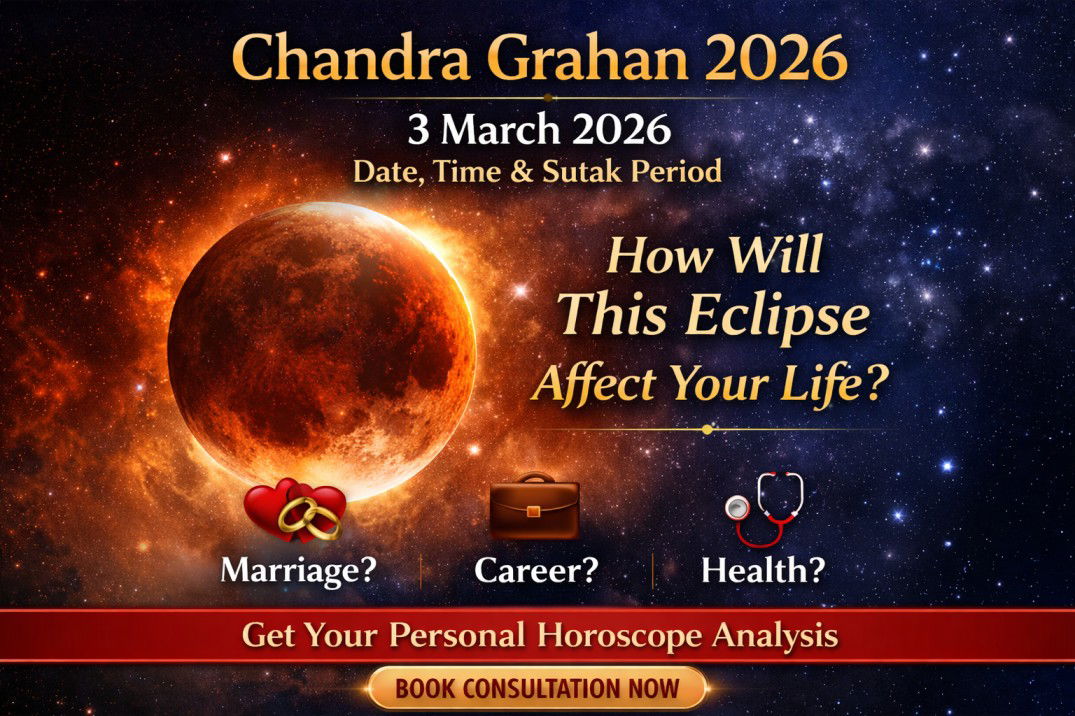
Chandra Grahan 2026 will take place in India on Tuesday, 3 March 2026.
Here are the eclipse timings in Indian Standard Time (IST):
* Date: 3 March 2026
* Penumbral Eclipse Begins: 2:14 PM IST
* Partial Eclipse Begins: 3:20 PM IST
* Maximum Eclipse: 5:04 PM IST
* Partial Eclipse Ends: 6:47 PM IST
* Penumbral Eclipse Ends: 7:53 PM IST
* Sutak Begins: 6:20 AM IST
You can see this eclipse in many parts of India around moonrise in the evening. It is important for both skywatchers and those interested in astrology.
What Is Chandra Grahan in Vedic Astrology?
A Chandra Grahan happens when the Earth moves between the Sun and the Moon, casting a shadow on the Moon. In astronomy, this is a natural event. In Vedic astrology, it is seen as the influence of Rahu and Ketu, the lunar nodes. Jyotish Shastra says Rahu temporarily covers the Moon. Because the Moon is linked to emotions, peace of mind, intuition, and maternal energy, this shadow symbolizes internal turbulence and subconscious release.
That is why lunar eclipses are seen as times of emotional change rather than physical harm.
Sutak Time for Chandra Grahan 2026
Sutak begins nine hours before the partial phase of the lunar eclipse. Since the partial eclipse begins at 3:20 PM IST, Sutak will start at approximately 6:20 AM IST on 3 March 2026.
Sutak is considered a spiritually sensitive period. During this time, traditional texts advise minimizing material activities and focusing on inner discipline. Temples may close, and certain rituals are paused.
The goal of Sutak is not to create fear, but to encourage awareness of energy.
What to Do During Chandra Grahan 2026
During the eclipse, spiritual practices are believed to be more effective because the Moon’s energy is changing. Meditation and chanting are especially beneficial.
Chanting “Om Som Somaya Namah” can help balance lunar energy. Sitting quietly and thinking about your emotions can also bring clarity. Many people use the eclipse to let go of negativity and set new intentions.
Taking a bath after the eclipse ends is considered a cleansing ritual. Preparing fresh food after the eclipse symbolizes renewal.
What Not to Do During Sutak
Traditionally, people avoid cooking or eating freshly made food during Sutak and the eclipse. Important events like weddings, engagements, or big financial decisions are usually delayed. This is discouraged in classical texts because it is considered a time for awareness rather than passivity.
These customs are based on culture and spirituality. They are about symbolic discipline, not physical risk.
Pregnancy Precautions During a Lunar Eclipse
During a Chandra Grahan, pregnant women are usually advised to stay indoors and avoid sharp objects. The main focus is on staying calm and emotionally steady.
Astrologically, the Moon represents maternal energy, so the tradition encourages greater awareness during this time. The main idea is to keep peace of mind.
Astrological Effects of Chandra Grahan 2026 on Zodiac Signs
The true impact of this eclipse depends on your birth chart. However, based on general transit principles:
If you are a fire sign (Aries, Leo, Sagittarius), this eclipse might make you want more clarity about your goals or career. If you feel restless, take it as a sign to reflect on the changes you need to move forward.
Earth signs (Taurus, Virgo, Capricorn) may feel like reviewing their finances and building more stability. This is a good time to make practical choices and check your priorities for steady progress.
Air signs (Gemini, Libra, Aquarius) might start rethinking how they handle relationships and communication. Take some time to look at your habits and see if a new approach could help you connect better.
Water signs (Cancer, Scorpio, Pisces) could experience heightened emotional sensitivity during this period. Embrace this increased intuition to understand personal needs and process deep feelings.
For more accurate predictions, you need to see which house the eclipse affects in your birth chart. If it is in your fourth house, emotional or home issues may come up. If it is in your tenth house, you might see changes in your career. Developments may unfold.
This is why a personalized Kundli analysis is essential.
Is Chandra Grahan 2026 Negative?
No.
In astrology, eclipses are transformative events. They reveal hidden truths. They bring suppressed emotions into awareness. They often trigger change that was already overdue.
Rather than fearing Chandra Grahan 2026, it is wiser to observe it as a karmic checkpoint. It is a moment to pause, reflect, and recalibrate.
Remedies for Chandra Grahan 2026
Simple remedies can help maintain emotional balance during the eclipse:
Chant lunar mantras, donate white foods like rice or milk after the eclipse, light a diya in the evening, and clean your home temple.
These remedies can help you feel more stable both mentally and spiritually.
Visibility in India
The lunar eclipse on 3 March 2026 will be visible in many parts of India at moonrise. How well you see it may depend on your city. People in western and northern India may see the later stages more clearly.
Check your local moonrise time for the best chance to see the eclipse clearly.
Frequently Asked Questions
1. Is Chandra Grahan 2026 safe to watch?
Yes, lunar eclipses are safe to watch with the naked eye. You do not need any special glasses.
2. Does Sutak apply if the eclipse is not visible in my city?
Traditionally, Sutak is observed when the eclipse is visible in the region. Since most of India will see it, Sutak is generally followed.
3. Can we eat during Chandra Grahan?
Many people choose to fast during the eclipse. However, elderly people, children, and those with health issues can decide what is best for them.
4. How does Chandra Grahan affect my horoscope?
The effect depends on your Moon sign, ascendant, and house placement. A personalized birth chart reading provides accurate insight.
Conclusion
Chandra Grahan 2026 on 3 March is both an astronomical and spiritual event. Knowing the right date, time, and Sutak period helps clear up confusion. Watching the eclipse with awareness, not fear, turns it into a chance for clarity.
If you want to know how this lunar eclipse might affect your marriage, career, finances, or health, a detailed horoscope readingbased on your birth details can give you personal answers.