
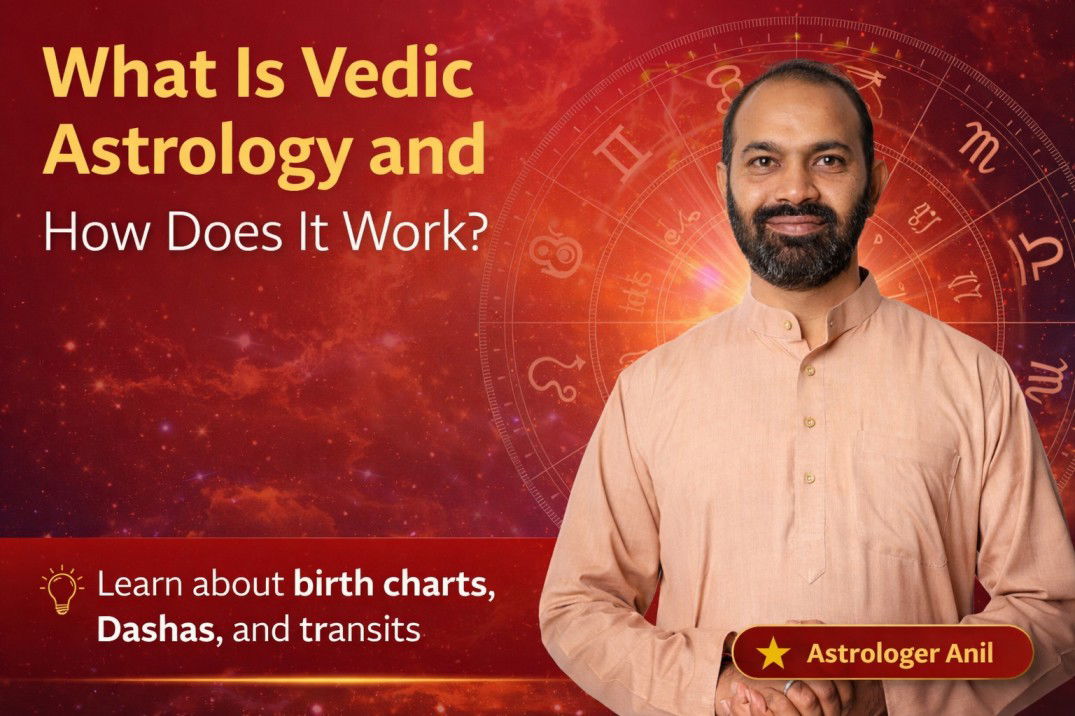
What Is Vedic Astrology and How Does It Work?
Vedic Astrology, or Jyotish Shastra, is an ancient Indian tradition exploring how planetary movements affect lives. “Jyotish” means “science of light,” showing how celestial bodies reveal human patterns. Practiced for millennia, it is known for its structure and mathematical approach.
Unlike the Sun-sign astrology found in magazines, Vedic astrology relies on your exact birth details and precise astronomical calculations. It uses the sidereal zodiac, which aligns with the actual constellations in the sky. This accuracy means that even a small change in birth time can change your chart’s meaning.
To truly benefit from this tradition, experienced astrologerslike Anil Bhargava approach chart reading with careful, traditional methods. This thoughtful practice naturally leads us to explore the building blocks that make Vedic astrology unique.
The Foundation of Vedic Astrology
Vedic astrology operates through three interconnected systems: the birth chart (Janam Kundli), planetary periods (Dasha), and planetary transits (Gochar). These three elements work together to explain both personality tendencies and life timing.
The birth chart acts as the blueprint. It is created using the exact date, time, and place of your birth. It shows where the planets were, spread across twelve houses. Each house represents a part of life, such as career, relationships, money, health, or identity.
Astrologers consider every planet’s strength, connections, and placement for a full chart analysis. This thorough perspective gives Vedic astrology its depth.
Also Read - How Accurate Is Vedic Astrology?A Clear and Honest Explanation
Understanding the Birth Chart
The twelve houses each reflect a life area: the first house indicates personality and appearance, the seventh covers marriage and partnerships, and the tenth relates to career and reputation.
Planets in these houses shape how those parts of life develop. If a planet is strong, things may go smoothly. If it is weak or troubled, there may be delays or challenges to overcome.
In practIn real consultations, Astrologer Anil points out that no chart is all good or all bad. Every chart has its strengths and challenges. The key lies in understanding timing and responding wisely.
The Role of the Nine Planets
Vedic astrology looks at nine main planets, called the Navagraha. These are the Sun, Moon, Mars, Mercury, Jupiter, Venus, Saturn, Rahu, and Ketu.
Each planet stands for certain traits and life themes. The Sun is about authority and energy. The Moon rules emotions and the mind. Saturn is linked to discipline, responsibility, and life lessons. Jupiter stands for growth, wisdom, and guidance.
The condition of these planets — whether strong, weak, exalted, or afflicted — determines how their themes are expressed in daily life. Interpretation requires both technical knowledge and experience.
What Is the Dasha System?
One of the most powerful tools in Vedic astrology is not just understanding the planets; timing in life is a key focus. The Dasha system is central to this. asha system. This system divides a person’s life into planetary periods. Each planet governs a certain number of years, activating themes related to its placement in the birth chart.
For example, during a Jupiter period, growth and opportunity may become prominent. During a Saturn period, life may demand discipline and structured effort. The Dasha system answers a crucial question in astrology: when will certain results become active?
Without dashas, astrology becomes static. With dashas, timing becomes visible.
What Are Transits in Vedic Astrology?
The birth chart stays the same, while the Dasha system explains long stretches of time; planetary transits highlight changes as planets keep moving. Here’s how transits work in Vedic astrology. These movements are called transits. When a moving planet connects with important points in your chart, it can spark events or changes inside you.
For example, when Saturn moves through your chart, it might bring more responsibility or changes. Jupiter’s movement often brings growth and learning. Rahu and Ketu can cause sudden, fated changes.
A professional reading looks at both dashas and transits. This way, you get a sense of long-term trends and short-term events.
How Vedic Astrology Differs From Western Astrology
One big difference is the zodiac system. Western astrology uses the tropical zodiac, based on the seasons. Vedic astrology uses the sidereal zodiac, which matches the real constellations.
Vedic astrology also puts more focus on the Moon sign and Ascendant, not just the Sun sign. It also weaves in ideas about karma more deeply.
Because of its structured timing systems, Vedic astrology is often considered more predictive and timing-oriented.
Can Vedic Astrology Predict the Future?
Vedic astrology does not say that. With all these systems in mind, it’s common to wonder: can Vedic astrology actually predict the future? It points out patterns, strengths, weaknesses, and good times to act. It works like a weather forecast: if rain is coming, you get ready. The forecast does not cause the rain, but it helps you prepare.
Astrologer Anil often explains that astrology is a decision-support system. It increases awareness, enabling individuals to act with clarity rather than uncertainty.
What Areas of Life Can It Help With?
People often turn to Vedic astrology. After learning what Vedic astrology can and cannot predict, it’s useful to consider the practical areas where it offers guidance.age , finances, business choices, and property. It can also give insight into health patterns and spiritual growth.
When used wisely, astrology encourages effort and smart choices. It does not take the place of personal responsibility or hard work.
Final Thoughts
Vedic astrology is a well-organized system based on astronomy, symbols, and centuries of study. It looks at birth charts, planetary periods, and transits to understand life’s timing and karmic patterns.
When interpreted carefully by experienced practitioners like Astrologer Anil, it becomes a practical framework for clarity and better decision-making. It encourages awareness, patience, and alignment with natural cycles.
Understanding planetary timing does not remove free will. Instead, it strengthens informed action.