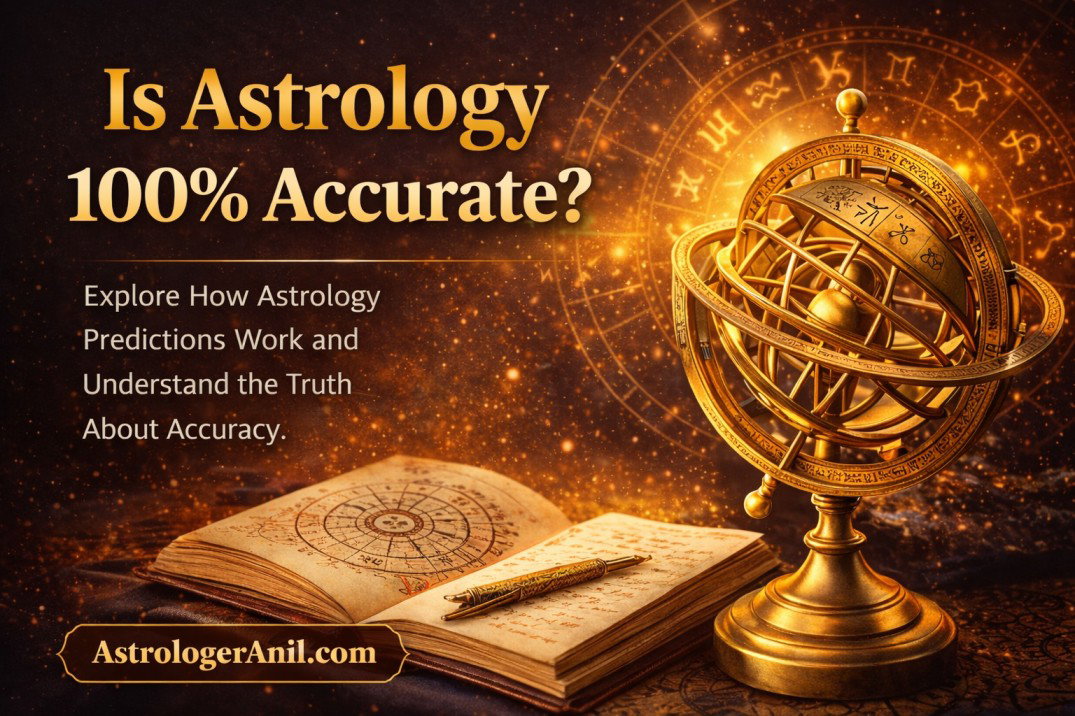

How Accurate Is Vedic Astrology?A Clear and Honest Explanation
Many people ask one important question before consulting an astrologer:
How accurate is Vedic astrology?
That’s a fair question.
Some people think astrology can predict everything with total accuracy, while others see it as just belief or coincidence. The reality is more balanced and practical.
Let’s clear this up.
What Does “Accuracy” Mean in Astrology?
Before we talk about accuracy, it helps to understand what astrology actually does.
Vedic astrology doesn’t make exact, minute-by-minute predictions.
Instead, it studies:
* Planetary positions at birth
* Timing cycles (Dasha periods)
* Planetary transits
* Strengths and weaknesses in the chart
This kind of analysis seeks trends, probabilities, and timing windows.
Accuracy means understanding life patterns and phases, not every detail.
Get your free kundali online today
Why Many Predictions Feel Accurate
People are often surprised when astrology describes their personality so well.
This happens because your birth chart reflects:
* Emotional style (Moon)
* Communication techniques (Mercury)
* Relationship approach (Venus)
* Career tendencies (10th house)
* Strengths and weaknesses
For example, someone with a strong Saturn influence might be naturally disciplined but face delays early in life. Someone with strong Jupiter influence may be drawn to teaching, advising, or guiding others.
These patterns aren’t random. They come from specific planetary combinations.
When understood well, they feel accurate because they match real-life experience.
The Role of Timing in Accuracy
One of the most important parts of Vedic astrology is the Dasha system.
Dasha refers to planetary time periods. Each person moves through different planetary phases during life.
For example:
* A Jupiter period may bring expansion, learning, and opportunity.
* A Saturn period may bring responsibility and restructuring.
* A Rahu period may bring sudden changes or unconventional paths.
Many people notice major life shifts during these periods. When astrology correctly identifies these timing cycles, accuracy increases significantly.
Timing often matters more than events.
Where Astrology Can Be Highly Accurate
Vedic astrology tends to be more accurate in certain areas:
1. Personality Analysis
Your emotional tendencies, decision style, strengths, and weaknesses are often described with surprising clarity.
2. Life Phases
Astrology can identify periods of growth, delay, struggle, or opportunity.
3. Relationship Patterns
It can highlight partners' compatibility strengths and emotional triggers.
4. Career Direction
It often shows whether a person is suited for structured work, creative fields, leadership, or advisory roles.
In these areas, astrology provides strong guidance.
If you are looking for trusted guidance, you can consult an experienced astrologer now
Where Astrology Has Limitations
Honesty matters.
Astrology does not:
* Replace personal effort
* Override free will
* Guarantee specific outcomes
* Predict small daily events accurately.
For example, astrology may show a strong marriage period approaching. However, whether you meet someone depends on your actions and environment.
Astrology shows timing and trends. You choose how to act.
Such a balance between destiny and free will is essential.
Why Some Predictions Fail
People sometimes say astrology is inaccurate because a prediction didn't come true.
There are usually three reasons:
1. Incorrect Birth Time
Even a small difference in birth time can change the interpretation of a chart.
2. Weak Interpretation
Astrology is complex. Interpretation skill matters more than calculation.
3. Unrealistic Expectations
Some expect exact dates and dramatic events. Astrology works inside broader cycles and probability windows.
Accuracy depends on the astrologer’s skill and clarity.
Science, Logic, and Belief
Vedic astrology is not modern laboratory science. However, it is a structured and time-tested system developed over thousands of years.
It is mathematical and rule-based. Planetary positions are exact, but interpretation needs skill.
You may see it as a guidance system rather than a strict science.
Many successful professionals consult astrology not because they blindly believe, but because they want additional perspective on timing.
Realistic Expectations from Astrology
If you approach astrology expecting miracles, you may feel disappointed.
However, if you approach it as:
* A tool for self-understanding
* A timing guide for major decisions
* A system to identify strengths and weaknesses
Then astrology becomes highly useful.
Astrology is most effective when used for guidance, not control.
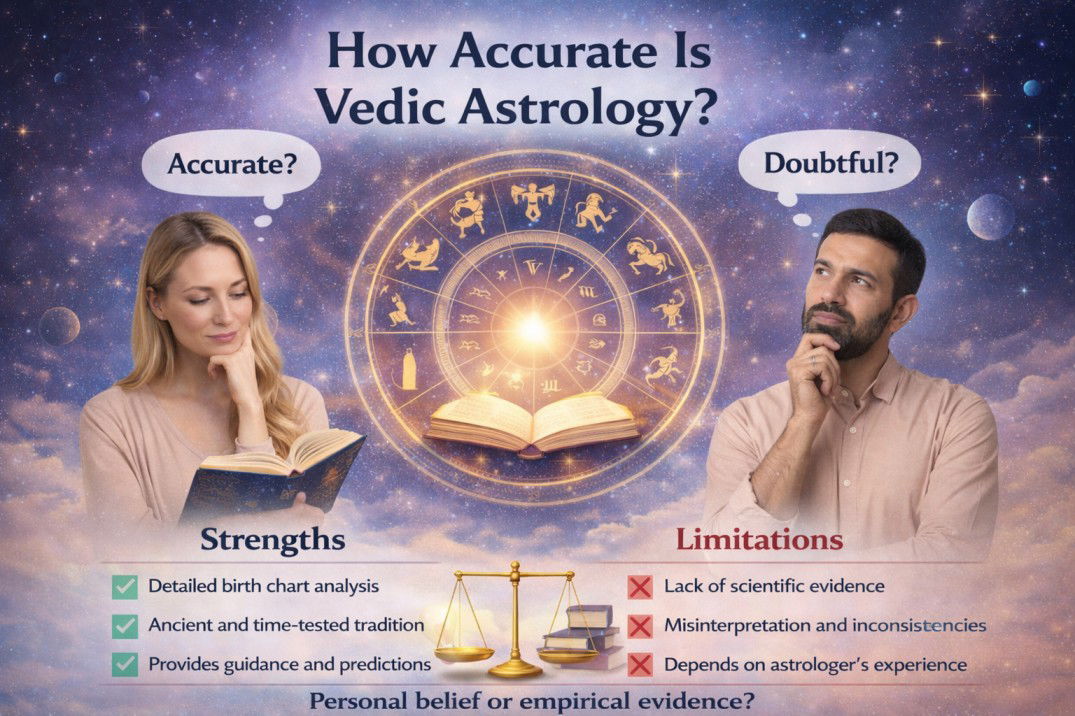
So, How Accurate Is Vedic Astrology?
The honest answer is this:
Vedic astrology can be highly accurate in identifying personality patterns, life phases, and decision timing. However, it does not eliminate free will or guarantee fixed outcomes.
It works best when:
* The birth details are correct.
* The interpretation is experienced.
* The client maintains realistic expectations.
When these conditions match, astrology becomes a powerful decision-support system.
Final Thoughts
Vedic astrology is not about fear or blind belief.
It is about awareness.
When you understand your planetary timing, you stop reacting blindly to events. You begin responding with clarity.
Accuracy in astrology is not about predicting every event. It is about correctly understanding life patterns and cycles.
Used wisely, it becomes a guide.
Used blindly, it becomes superstition.
The difference consists in understanding.