
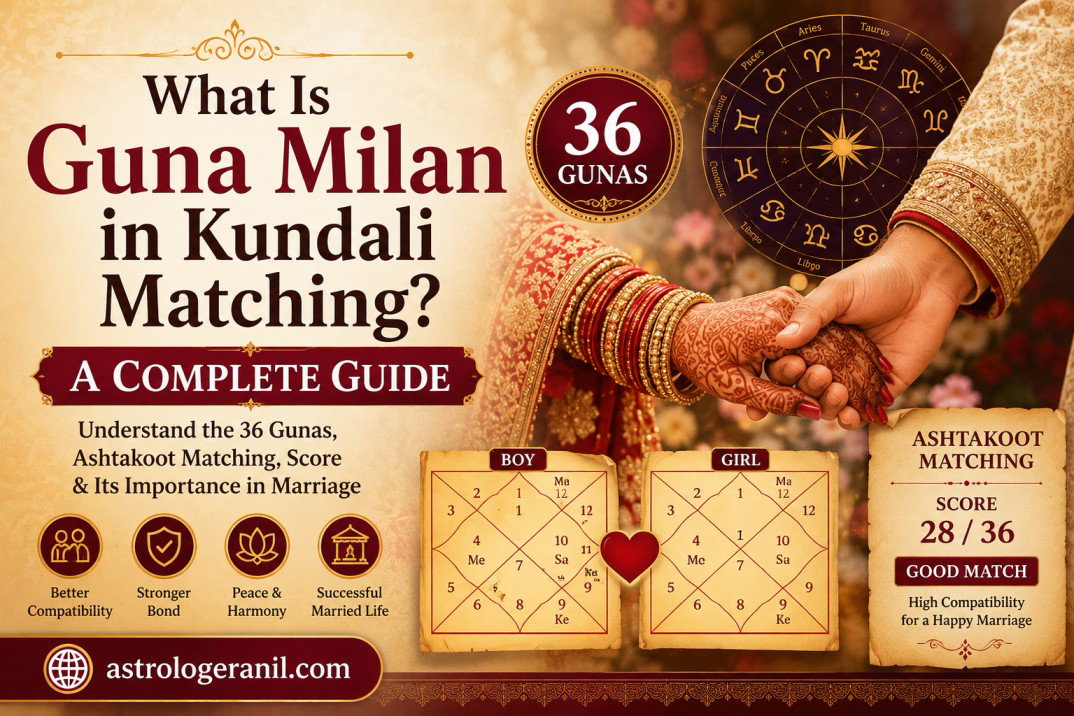
What Is Guna Milan in Kundali Matching? A Complete Guide
Marriage is one of the most important decisions in a person’s life.
In India, families have used Vedic astrology to assess compatibility before marriage for thousands of years. One of the oldest and most trusted methods is called Guna Milan.
Most people have heard the term. Far fewer understand what it actually measures — and what it doesn’t.
I have been doing kundali matching readings for over 15 years. Based on the Bhargava tradition of Jyotisha,
I have seen what a proper Guna Milan analysis can reveal and where people often misread the results.
This guide explains exactly what Guna Milan is, how the scoring works, what each of the 8 kootas means, and how to use the score correctly before making a decision about marriage.
Table of Contents
What Is Guna Milan?
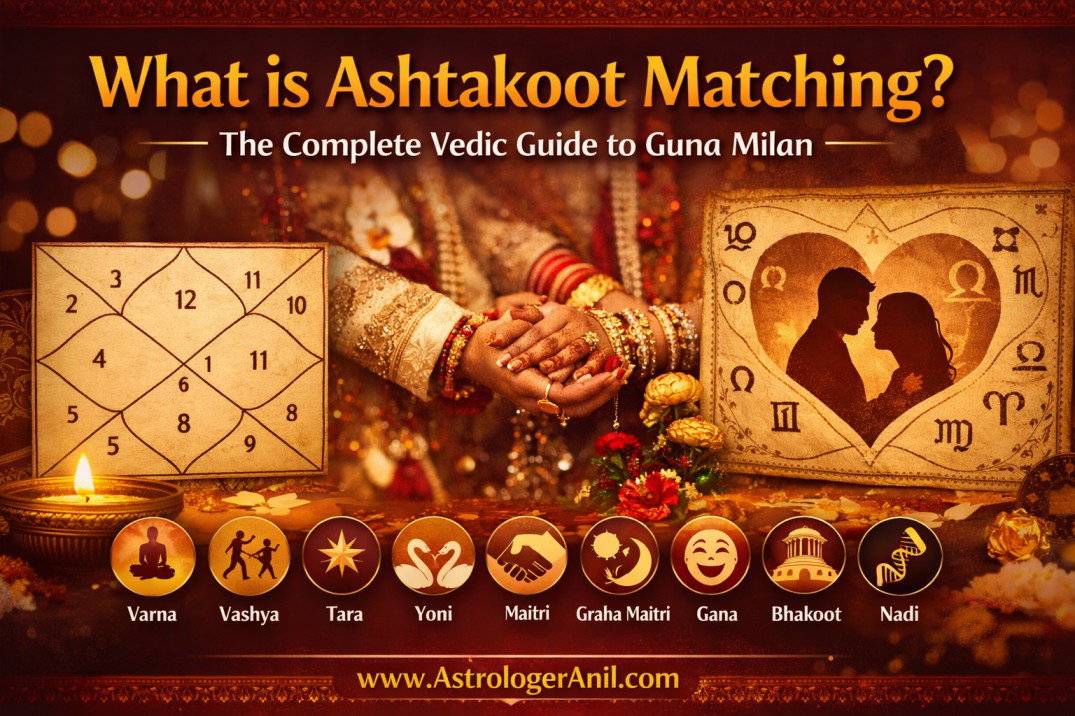
Guna Milan is the Vedic astrology method used to assess compatibility between a bride and groom before marriage. It is also called Ashtakoot Milan.
The word “guna” means quality or virtue. “Milan” means union or meeting. So Guna Milan literally means the matching of qualities.
The process compares the birth charts of both individuals. Specifically, it compares the Moon signs (Rashi) and Moon nakshatras (birth stars) of the two people. It does not look at the full horoscope in this calculation — it focuses on the Moon’s placement.
The result is a score out of 36 points.
This score comes from 8 specific categories called kootas. Each koota tests a different dimension of compatibility. Each carries a different maximum number of points.
Before we go through each koota, one important thing to understand: Guna Milan is a starting point, not a final verdict. A high score does not guarantee a happy marriage. A low score does not mean the marriage will fail. This is something I will come back to at the end.
For now, try the free kundali matching tool to generate your Guna Milan score and see how your birth charts compare.
Why the Moon Is Used in Guna Milan
You might wonder — why does Guna Milan focus on the Moon and not the Sun or the Lagna?
In Vedic astrology, the Moon represents the mind, emotions, habits, and how a person relates to others in daily life. The Sun represents the soul and identity. The Lagna (ascendant) represents the physical body and life path.
Marriage is a relationship lived day to day. It depends more on emotional compatibility than on any other factor. Two people may have excellent careers, matching ambitions, and similar values — but if their emotional rhythms clash, the marriage will be difficult.
The Moon’s placement at birth reveals how a person thinks, reacts, and connects emotionally. Comparing the Moon positions of two individuals gives a detailed picture of how well their inner natures will align in a shared life.
This is why Vedic astrology uses the Moon — and specifically the nakshatra — as the foundation of Guna Milan.
The 8 Kootas in Guna Milan
The Ashtakoot system uses 8 kootas. “Ashta” means eight. Each koota tests a different dimension of compatibility. Together they add up to a maximum of 36 points.
Below is a complete table of all 8 kootas.
Koota Name What It Tests Max Points
# | Koota Name | What It Tests | Max Points |
1 | Varna | Spiritual compatibility and values alignment | 1 |
2 | Vashya | Mutual influence and emotional control in the relationship | 2 |
3 | Tara | Health, well-being, and longevity compatibility | 3 |
4 | Yoni | Physical and sexual compatibility | 4 |
5 | Graha Maitri | Mental compatibility and planetary friendship | 5 |
6 | Gana | Temperament compatibility — nature and behaviour patterns | 6 |
7 | Bhakoot | Emotional bond, love, and financial compatibility | 7 |
8 | Nadi | Health of children and physical constitution compatibility | 8 |
Total | 36 |
Now, let us go through each koota in detail.
1 Varna Koota — Spiritual Compatibility (Max: 1 Point)
Varna refers to the spiritual classification of the two individuals based on their Moon sign. There are four varnas: Brahmin, Kshatriya, Vaishya, and Shudra.
This koota checks whether the spiritual level and core values of the two people are compatible. In practice, it is the least significant of the 8 kootas.
The groom’s varna should be equal to or higher than the bride’s varna for the point to be awarded. If they match, you get 1 point. If they don’t, you get 0.
2 Vashya Koota — Mutual Influence (Max: 2 Points)
Vashya measures the power dynamic in the relationship. It shows who holds more natural influence over whom.
Each Moon sign falls into one of five groups: human (manava), quadruped (chatushpada), crawling (jalchara), small (keet), or wild (vanchar).
Ideally, the two Moon signs should fall in groups where one naturally follows or complements the other. Full compatibility gives 2 points. Partial compatibility gives 1 point. No compatibility gives 0.
3 Tara Koota — Health and Well-being (Max: 3 Points)
Tara checks the compatibility of the bride and groom's nakshatras with respect to health, longevity, and general well-being during married life.
It is calculated by counting from the bride’s nakshatra to the groom’s nakshatra, and vice versa, and dividing by 9. The remainder determines compatibility.
Good Tara matching suggests that the two individuals will support each other’s health and that the marriage will be generally stable. Poor matching can indicate health challenges or periods of difficulty that one partner may bring to the other.
4 Yoni Koota — Physical Compatibility (Max: 4 Points)
Yoni koota tests sexual and physical compatibility between the two individuals.
Each of the 27 nakshatras is associated with a specific animal — horse, elephant, sheep, serpent, dog, cat, rat, cow, buffalo, tiger, deer, monkey, lion, and mongoose. Some animals are natural companions. Some are neutral. Some are enemies.
If both nakshatras fall under the same animal, you get 4 points. If the animals are friendly, you get 3 points. Neutral pairings get 2. Unfriendly gets 1. Enemy pairings get 0.
This koota matters significantly in marriage compatibility analysis because physical compatibility affects the quality of a couple’s daily life together.
5. Graha Maitri Koota — Mental Compatibility (Max: 5 Points)
Graha Maitri checks the friendship between the ruling planets (lords) of the Moon signs of the two individuals.
For example, if one person’s Moon is in Aries (ruled by Mars) and the other’s Moon is in Leo (ruled by the Sun), and Mars and the Sun are friendly planets, then Graha Maitri is strong.
This koota represents how well the two minds will align — how they think, communicate, process problems, and approach life’s decisions together. It is one of the more important kootas in modern readings because it reflects intellectual and mental harmony.
Full planetary friendship gives 5 points. Friendly gives 4. Neutral gives 3. Partial enmity gives 1. Full enmity gives 0.
You can get your free kundali matching report to check your Graha Maitri score, along with the full 36-point analysis.
6 Gana Koota — Temperament Compatibility (Max: 6 Points)
Gana is one of the most discussed kootas in marriage compatibility. It divides people into three temperament types based on their nakshatra:
Deva (Divine): Gentle, spiritual, idealistic, patient. Manushya (Human): Balanced, practical, emotionally engaged. Rakshasa (Fierce): Intense, independent, passionate, strong-willed.
The ideal match is same-gana. Two Deva individuals will generally be very compatible in temperament. Similarly, for two Manushya or two Rakshasa individuals.
Deva-Manushya pairings are considered acceptable. Deva-Rakshasa is the combination that astrologers watch most carefully — the contrast in temperament can lead to friction.
Full score: 6 points (same gana). Partial: varies. Lowest compatibility: 0 points.
In my experience, Gana Koota is one of the areas where exceptions exist. A Deva-Rakshasa pairing with strong Graha Maitri and good Bhakoot can still work well. Context always matters.
7 Bhakoot Koota — Emotional and Financial Compatibility (Max: 7 Points)
Bhakoot carries the second-highest weightage in the system. It measures the relationship between the two individuals' Moon signs based on their distance from each other.
The Moon sign positions are counted from one partner’s Rashi to the other’s. Certain combinations are considered auspicious. Others are considered unfavorable.
Favourable combinations: 1/7, 3/11, 4/10 Rashi relationships. Unfavourable combinations: 2/12, 5/9, 6/8 Rashi relationships.
Bhakoot is strongly connected to financial prosperity and emotional closeness in marriage. A poor Bhakoot score is taken seriously by astrologers, though it can be offset by a strong overall score and favorable planetary positions in the full chart.
Good Bhakoot gives 7 points. An incompatible combination gives 0.
8 Nadi Koota — Health of Children and Physical Constitution (Max: 8 Points)
Nadi carries the highest points in the entire Guna Milan system — 8 out of 36. This reflects how seriously the classical texts treat this compatibility factor.
Nadi refers to a person's physical constitution and life energy. The three nadis are Adi (Vata — wind), Madhya (Pitta — fire), and Antya (Kapha — water).
For a strong Nadi match, the two individuals must belong to different nadis. If both the bride and groom have the same Nadi, it is called Nadi Dosha.
Nadi Dosha is considered one of the most serious doshas in Guna Milan. It traditionally indicates challenges related to health, fertility, and children's well-being.
Different Nadi: 8 points. Same Nadi: 0 points — and Nadi Dosha applies.
How to Read Your Guna Milan Score
Once the 8 kootas are calculated, the scores are added to give a total out of 36. Here is how to interpret the total score.
Score Range Interpretation Marriage Advice
Score Range | Interpretation | Marriage Advice |
0 – 17 | Poor compatibility | Not recommended without detailed full-chart analysis |
18 – 24 | Acceptable compatibility | Proceed with caution; check full chart carefully |
25 – 32 | Good compatibility | Generally considered a strong match |
33 – 36 | Excellent compatibility | Rare; considered very auspicious |
The minimum acceptable score in traditional practice is 18 out of 36. Most families and astrologers consider 24 or above to be a reasonable match. A score of 28 and above is considered good. Scores above 32 are rare and considered highly auspicious.
However — and this is important — the score alone does not decide anything.
What the Score Does Not Tell You
Guna Milan is one tool. It is not the entire picture.
I have seen couples with 28/36 who had severe ongoing conflict. I have also seen couples with 19/36 who built strong, stable marriages over decades.
The Guna Milan score does not account for the placement of the 7th house in either chart, the strength of Venus and Jupiter, the dasha (planetary period) running at the time of marriage, the role of Mars and Mangal Dosha, or the overall karmic alignment of both horoscopes.
A score of 24 on its own tells you relatively little. What matters is whether the full birth chart supports the marriage — not just the Moon’s position.
This is why I always recommend a complete kundali reading before making a final decision. Get your free birth chart here as the first step, then check compatibility with the matching tool.
Doshas to Watch in Guna Milan
Even with a good overall score, certain doshas can affect the quality of a marriage. The three most significant ones:
Nadi Dosha — Same Nadi for both individuals (0 points in Nadi Koota). Traditionally associated with health challenges and difficulties related to children. Certain exceptions apply — for example, if both are from the same gotra, some texts treat it differently.
Bhakoot Dosha — A 6/8 or 5/9 Rashi relationship between the two Moon signs. Associated with emotional distance and possible financial instability.
Gana Dosha — A Deva-Rakshasa pairing. Associated with temperament clashes and power struggles in the relationship.
These doshas can sometimes be offset by favorable placements in the full charts of both individuals. But they should always be identified and discussed before finalizing a match.
Guna Milan vs Full Kundali Matching
Many people think Guna Milan is the same as kundali matching. It is not.
Guna Milan is one specific calculation within the broader process of kundali matching. A full kundali matching analysis also examines:
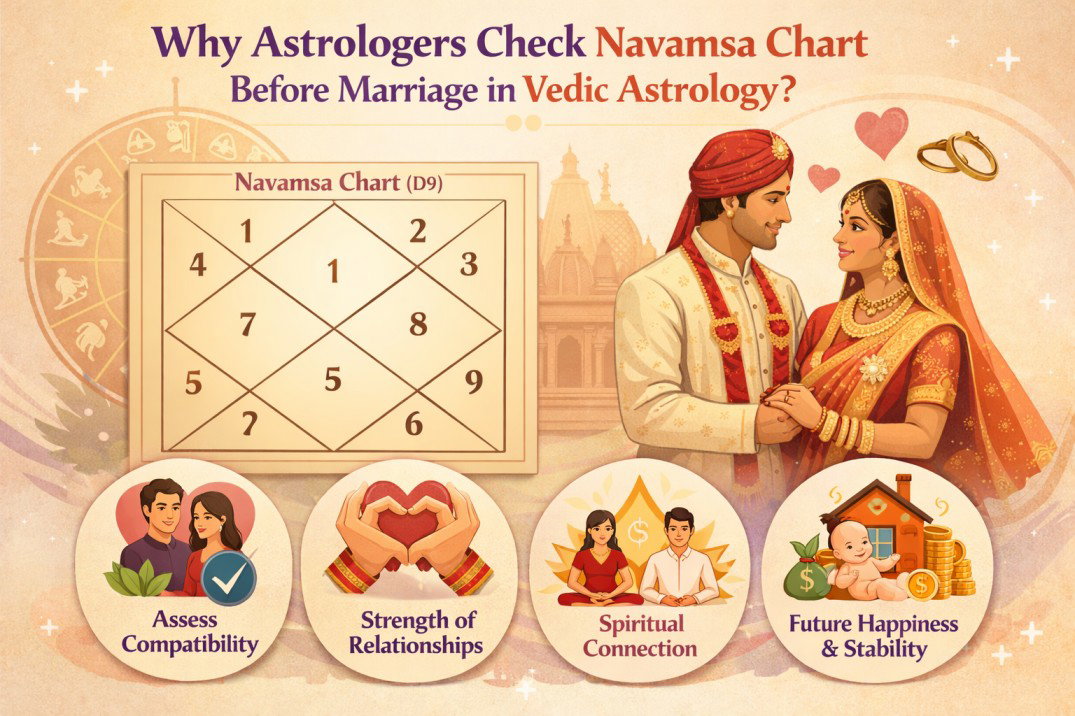
The 7th house and its lord in both charts — this is the primary house for marriage. The placement and strength of Venus in both charts — Venus governs love, relationships, and marital happiness. Mars and Mangal Dosha — malefic Mars placements can affect marital harmony. The Navamsa chart (D9) — which shows the deeper nature of the marriage itself. Dasha timing — whether the current planetary period supports marriage.
Guna Milan gives you a compatibility score based on the Moon’s position. Full kundali matching gives you the complete picture.
For the most reliable reading before a marriage decision, book a personal kundali matching consultation where both full charts are analyzed together.
Your Guna Milan score is a starting point — not the final word. To understand what your birth charts actually say about marriage compatibility, Astrologer Anil Bhargava analyses your full horoscope — 7th house, Venus, Navamsa, dasha timing, and Guna Milan together. 15+ years of experience | 1 lakh+ consultations | Bhargava lineage WhatsApp Now → +91 9979122221 | ₹1,100 for 30 minutes |
Frequently Asked Questions About Guna Milan
What is Guna Milan in kundali matching?
Guna Milan is the Vedic astrology method used to assess compatibility between a bride and groom before marriage. It compares their Moon signs and nakshatras across 8 categories called kootas. The result is a score out of 36 points. A higher score suggests better compatibility. The minimum acceptable score is traditionally 18 out of 36.
What does “guna” mean in astrology?
In Vedic astrology, “guna” means quality or virtue. In the context of kundali matching, it refers to the compatibility points awarded in each of the 8 kootas (categories). The total score — called the guna score or guna milan score — is out of 36.
How many gunas should match for marriage?
The traditional minimum is 18 out of 36. A score between 18 and 24 is considered acceptable. A score between 25 and 32 is considered good. Anything above 32 is considered excellent. However, the score must always be evaluated alongside the full horoscopes of both individuals.
What are the 8 kootas in Guna Milan?
The 8 kootas are: Varna (1 point), Vashya (2 points), Tara (3 points), Yoni (4 points), Graha Maitri (5 points), Gana (6 points), Bhakoot (7 points), and Nadi (8 points). Together they total 36 points.
Is Guna Milan the same as kundali matching?
No. Guna Milan is one part of kundali matching. A complete kundali matching analysis also covers the 7th house, Venus, Mangal Dosha, the Navamsa chart, and dasha timing. Guna Milan gives a Moon-based compatibility score. Full kundali matching gives the complete picture.
What is Nadi Dosha, and how serious is it?
Nadi Dosha occurs when both the bride and groom share the same Nadi (Adi, Madhya, or Antya). It is considered one of the most serious doshas in Guna Milan and traditionally indicates challenges related to health and children. However, certain exceptions apply based on gotra, other chart factors, and specific classical texts. A proper chart reading is needed to assess severity.
Can a low Guna Milan score be overridden?
A low score does not automatically make a match unsuitable. If the full horoscopes of both individuals show strong 7th house support, good Venus placement, and compatible dashas, many experienced astrologers will recommend proceeding despite a lower guna score. The full chart context always matters more than the score alone.
Is 18 out of 36 guna milan good enough for marriage?
18 is the traditional minimum. It is considered acceptable but not ideal. Most astrologers would recommend getting a full kundali reading alongside the guna score before deciding on a match with 18 points. Some important kootas — particularly Nadi, Bhakoot, and Gana — carry heavy weight. If these scores are zero, the overall 18 may be less meaningful.
What is Bhakoot Dosha?
Bhakoot Dosha occurs when the Moon signs of the two individuals fall in a 6/8 or 5/9 Rashi relationship. It results in 0 points for the Bhakoot Koota. This dosha is associated with emotional and financial challenges in married life. Like Nadi Dosha, it can be partially mitigated by other factors in the chart.
Does Guna Milan consider the full horoscope?
No. Guna Milan is based solely on the Moon signs and the nakshatras of both individuals. It does not consider the Lagna, the Sun sign, planetary positions in other houses, or dasha periods. This is why Guna Milan should always be supplemented with a full kundali analysis before a marriage decision.
Check Your Guna Milan Score Free
You can check the Guna Milan compatibility between any two birth charts using the free kundali matching tool on this site. Enter both birth details — date, time, and place of birth — to get a full breakdown of all 8 kootas and the total score.
If you want to understand what the score means in the context of both full horoscopes, book a personal consultation. A 30-minute reading covers Guna Milan, the 7th house, Venus, Navamsa, Mangal Dosha, and timing — everything you need to make a confident decision.
WhatsApp → +91 9979122221 | ₹1,100 for 30 minutes